India Reaffirms Commitment to End HIV/AIDS as a public health threat by 2030
HIV/AIDS as a public health threat

New annual HIV infections have decreased by 44% since 2010, outperforming the global reduction rate of 39%: Patel

“India offers comprehensive HIV and Syphilis testing to all pregnant women with more than 30 million free HIV tests being conducted annually”

Delhi, Sept 25
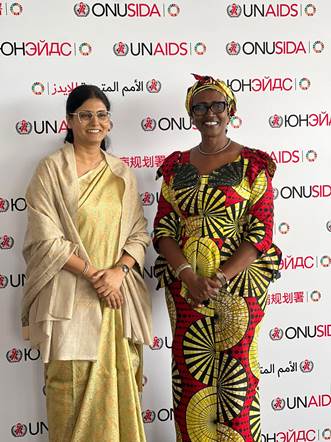
Union Minister of State for Health and Family Welfare Anupriya Singh Patel addressed a high-level side event at the United Nations on the theme “Revitalized Multilateralism: Recommitting to Ending AIDS Together.” The event was organized by UNAIDS, the Global Fund, and PEPFAR.

In her intervention, the Minister reaffirmed India’s commitment to achieving the United Nations’ Sustainable Development Goal (SDG) of ending HIV/AIDS as a public health threat by 2030. The Minister outlined India’s progress and key strategies in the ongoing fight against HIV/AIDS, including the 5th phase of the National AIDS and STD Control Programme (2021-2026), fully funded by the Government of India. As per the recent India HIV Estimations 2023 report, over 2.5 million people are living with HIV in India, but thanks to concerted efforts, the adult HIV prevalence is at 0.2 % and estimated annual new HIV infections are at around 66,400. New annual HIV infections have decreased by 44% since 2010, outperforming the global reduction rate of 39%.

“India has made great strides in combating HIV/AIDS through innovative programs and robust partnerships,” the Minister said, pointing to a variety of youth-targeted initiatives like Red Ribbon Clubs in educational institutions and mass-awareness activities such as the annual RED RUN Marathon.

Smt. Patel pointed out that “India offers comprehensive HIV and Syphilis testing to all pregnant women with more than 30 million free HIV tests being conducted annually”. “In total, more than 1.7 million people are receiving free Anti-retroviral Therapy (ART) through public healthcare systems”, she said.

She also highlighted India’s role as the world’s largest supplier of anti-retroviral drugs. The country currently supplies over 70% of global anti-retroviral medicines, ensuring affordable access for nations in need. “We are proud to contribute to the global fight against HIV/AIDS by making quality treatment accessible worldwide,” said the Minister.

Smt. Patel said that “efforts to address stigma around HIV have been bolstered through the HIV and AIDS (Prevention and Control) Act 2017, which ensures that all Indian states appoint ombudsmen to handle grievances and promote HIV prevention policies. Additionally, India’s approach to integrating national health programs, including efforts to tackle tuberculosis, viral hepatitis, and non-communicable diseases, is helping address co-morbidities faced by people living with HIV”.

The Minister concluded her address by urging continued global cooperation, stating, “Breaking silos and building synergies is the mantra of the Government of India. Through collaboration, we will strengthen the fight against HIV/AIDS and build a healthier world for all.”

The Government of India remains steadfast in its goal of ending HIV/AIDS as a public health threat by 2030 through inclusive strategies, partnerships, and renewed multilateralism.

Raipur Sahitya Utsav 2026: A National Celebration of Chhattisgarh’s Literary Spirit* *Three-day event to be held at Purkhouti Muktangan, Nava Raipur from January 23 to 25* Raipur, January 19, 2026// With the aim of giving national recognition to Chhattisgarh’s rich literary, cultural and intellectual traditions, the Raipur Sahitya Utsav 2026 is being organized on January 23, 24 and 25, 2026 at the Purkhouti Muktangan in Nava Raipur Atal Nagar. The three-day festival is set to become a strong platform for literature, culture and dialogue, drawing large participation from writers, thinkers, readers and literature enthusiasts from across the State and the country. Nearly 120 renowned writers and literary figures from Chhattisgarh and other parts of India are scheduled to attend. A total of 42 literary sessions will be held during the festival, featuring in-depth discussions on contemporary social, cultural, political and intellectual themes. The sessions will include discussions on subjects such as intellectual discourse, the Indian knowledge tradition, the Constitution, cinema and society, the country’s new awakening, literature in Chhattisgarh, literature through the lens of history, and the standard of language and literature in educational institutions, addressing key intellectual concerns of the present time. In addition, detailed discussions will be held on Natyashastra and artistic traditions, literature and politics, contemporary women’s writing, tribal literature, Chhattisgarh’s folk culture, tourism, journalism and governance. Contemporary issues such as challenges faced by publishers, writing in the digital age, and readers in the digital era will also remain at the centre of discussions. Preparations are underway, with the administration targeting completion of all arrangements by January 21. Work related to the stage, pavilions, technical arrangements, decoration and other essential facilities is being finalized at the venue. The festival will be inaugurated on January 23 by Rajya Sabha Deputy Chairman Shri Harivansh Narayan Singh. The inaugural ceremony will also be attended by Chief Minister Shri Vishnu Deo Sai and Dr Kumud Sharma, Vice-Chancellor of Wardha International Hindi University. The festival will conclude on January 25 in the presence of State ministers and eminent literary and cultural personalities including Dr Sachchidanand Joshi and Dr Chandraprakash Dwivedi. A major attraction of the festival will be the special staging of the popular play ‘Chanakya’ by noted writer and theatre artist Shri Manoj Joshi, scheduled on January 23 at 7 pm. The festival will also feature participation by Shri Nitish Bharadwaj, who played Lord Krishna in the Mahabharat television series, and acclaimed filmmaker Shri Anurag Basu. A special poetry reading will be held on January 24 in memory of former Prime Minister Shri Atal Bihari Vajpayee. Four separate pavilions have been set up at the venue for discussions and sessions. The main pavilion has been named after Chhattisgarh’s only Jnanpith Award-winning author, late Shri Vinod Kumar Shukla. The second pavilion has been named after Pt Shyamlal Chaturvedi, the third after Bastar’s noted writer Lala Jagdalpuri, and the fourth after author Aniruddh Neerav. A large book fair will also be organised at the venue, where around 15 national-level publishers including Prabhat Prakashan, Rajkamal Prakashan, Saraswati Book, Yashasvi Prakashan, Hind Yugm Prakashan and Rajpal Prakashan will showcase and sell their books. Books written by Chhattisgarh’s authors as well as school students will also be displayed. Proper arrangements have also been made for the launch of new books authored by writers participating in the festival. An attractive exhibition showcasing Chhattisgarh’s development over the last 25 years will be put up at the venue. A talent zone has been created for local youth and folk artists, featuring poetry recitations, story readings, folk dance and musical performances. Daily quiz competitions will also be organised, with winners receiving prizes and certificates. To facilitate travel from Raipur to Purkhouti Muktangan, the administration is arranging around 20 free buses on six routes, including Railway Station, Bus Stand, Tatibandh and Telibandha. Over 500 officers and staff are engaged in managing arrangements for the successful conduct of the festival. About 15 food stalls are also being set up at the venue, offering local cuisine including traditional Chhattisgarhi dishes. All essential facilities including drinking water, cleanliness and toilets are being ensured at the venue. Raipur Sahitya Utsav 2026 stands as a strong national showcase of Chhattisgarh’s intellectual spirit, cultural heritage and contemporary thought. The festival aims to connect society through literature, dialogue and culture, while further strengthening interest among the younger generation in reading, expression and creativity.